
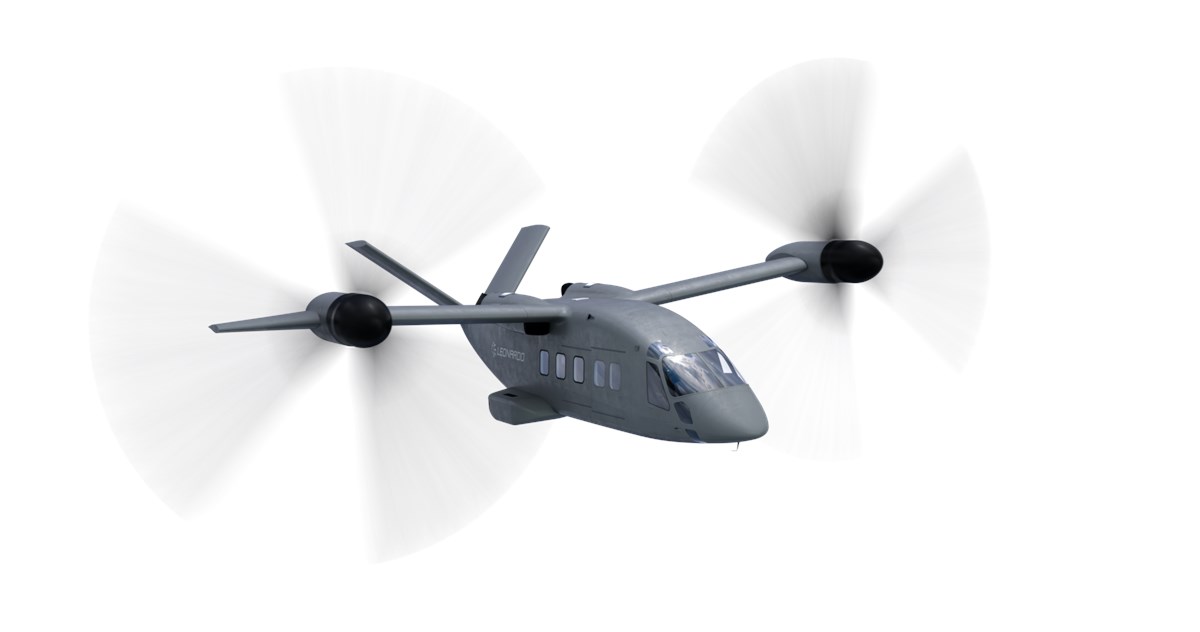
Several NATO member states are looking to commission the development of a new type of helicopter. This is intended to replace the current medium-lift helicopters in ten to fifteen years’ time. As part of one of the exploratory projects, led by the Italian company Leonardo, experts from NLR have conducted an in-depth analysis of the concept of a tiltrotor helicopter. The results of that research were presented this week at the Vertical Flight Society’s 82nd Annual Forum & Technology Display, a major trade conference in the United States.
Several countries within NATO, including the Netherlands, France, Germany, Italy, and Canada, are working together to develop a new medium-lift helicopter. The current machines in this class are nearing the end of their service life and will need to be replaced around 2035-2040.
Therefore, the NATO Support and Procurement Office commissioned three helicopter manufacturers to develop concepts for a new type of helicopter. This contract is part of the NATO Next Generation Rotorcraft Capability programme.
One of the three companies is Leonardo, a major Italian helicopter manufacturer. That company has developed a concept design for a so-called tiltrotor helicopter. NLR was asked to carry out a comprehensive analysis of this concept. Firstly, the flight characteristics were investigated. Second, the question was how the helicopter concept could function when taking off from and landing on a naval ship. Finally, Leonardo wanted more insight into how its helicopter concept could perform during operations, in conjunction with other units.
Why NLR?
The Royal Netherlands Aerospace Centre (NLR) has a lot of in-house knowledge about helicopters. Another strong point is that NLR is close both to industry and to the Dutch Ministry of Defence, which uses the helicopters. It is also important that NLR operates as an independent research centre. “The Netherlands itself has no industry that builds helicopters”, says Stefan van ‘t Hoff, Principal R&D Engineer and Team Leader Vertical Flight at NLR and project leader of the study. “One day we work for one manufacturer, and the next day for another.”
What is a tiltrotor?
Leonardo’s design falls into a special category of aircraft. When the propellers of a tiltrotor are directed upward, the aircraft functions like a helicopter; the aircraft can then take off vertically. When it gains speed, the propellers turn forward. At this point they function like the propellers on a turboprop airplane.
Flight characteristics
To analyse the flight characteristics of Leonardo’s tiltrotor concept, NLR engineers designed a completely new concept for the flight control system, the software that controls a helicopter. This was used to run simulations of various possible manoeuvres of the aircraft. These simulations and calculations showed that the Leonardo helicopter concept can achieve a good level of flying characteristics.
Ships
The new helicopter of the NATO countries must also be able to land on ships. This scenario was also part of the analysis by NLR. The special challenge here is that most European countries, unlike the U.S., do not have aircraft carriers. This means the future helicopter must be able to land on frigates, which are much smaller ships, making the influence of the ship’s buildings on local wind currents much greater. “The buildings on a moving ship create a wake (a chaotic airflow, ed.) in which the helicopter must be able to land”, says Van ‘t Hoff. “A helicopter can be bothered by such a drag. However, these limitations are known, and NLR has accumulated a lot of knowledge about them in fifty years of research.”
Simulations with a digital ship model showed that Leonardo’s tiltrotor concept will be able to land on a frigate and take off. A tiltrotor may be even more suitable for this scenario than a conventional helicopter, thanks to the symmetrical design of the two rotors. The craft has multiple control surfaces to compensate for its position, says Van ‘t Hoff. “For example, it can use its tail plane to straighten the helicopter.”
Simulation environment
The third aspect that the NLR specialists examined was how Leonardo’s tiltrotor concept could work in practice, during operations. To do this, they used an existing simulation environment. Here they tested how the helicopter cooperates and communicates with troops on the ground and with other aircraft in the air, or even with satellites in space. The simulations took into account the main characteristics of the helicopter, such as flight behaviour, on-board defence systems, fuel consumption, data connections and so on.
The exact results of these simulations are not made public. But new insights have emerged about the possibilities and limitations of the tiltrotor concept in conjunction with other army units.
What’s next?
With the help of – among other things – the findings of this NLR study, NATO will be able to adjust its requirements for the new helicopter, says Van ‘t Hoff. This will start a new round of concept studies which, after a choice for the manufacturer, should lead to the final design. NATO’s aim is to have a new helicopter available for order by around 2035, which various countries will then be able to use.